Read and Play with CONNETIX

Tags
Have you felt the excitement when your child begins recognising and tackling new words on their own? When they suddenly start sounding out words on signs or menus, trying to make sense of the world around them? It’s one of those lightbulb moments that feels like the start of something big.
But what next? Rather than diving into the heavily marketed educational workbooks and flashcards, you can continue to lay the groundwork for early reading at home through play.
Children learn best through play….in fact, play is learning! Research shows that young children learn most effectively through active, hands-on exploration rather than passive, structured instruction. In the early years, the brain is extremely adaptable; continually forming and strengthening neural connections in response to sensory rich, engaging experiences. This means providing play-based learning opportunities for children is hugely beneficial.
CONNETIX create an ideal foundation for this type of learning. They are naturally inviting, engaging and the perfect open-ended tool for learning. Below are a few games to try using CONNETIX to foster early reading skills.
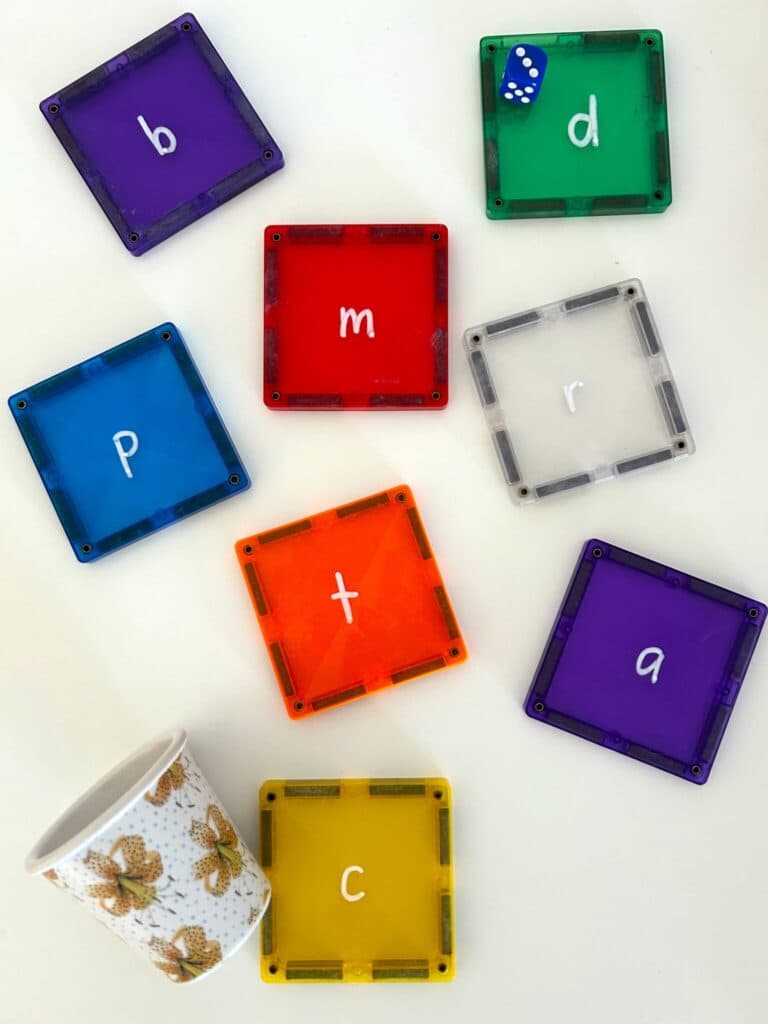
This game consolidates initial and final sounds, plus builds vocabulary. You will need square tiles, a chalk maker and timer to play.
Write sounds/ letter patterns – using a chalk marker, write sounds or letter patterns on individual tiles. For example, on separate tiles write ‘s’, ‘b’, ‘sh’ and ‘ch’. Try using five tiles to start with. To increase complexity of the game, increase the number of tiles with sounds.
This game helps children build sentences by combining fun words from different categories. You will need square tiles, a chalk marker and dice to play.
This game helps practice and consolidate sound patterns by sorting words based on similar phonetic features. You will need triangle tiles, square tiles and a chalk marker.
This game is a great introduction to word building and letter recognition. You will need square tiles, a chalk marker, timer and a piece of paper or whiteboard.

Emma is an enthusiastic early childhood educator and the proud mother of two incredibly curious children, aged 5 and 3. Her passion for nurturing young minds is evident in her dedication to play-based learning. Emma delights in creating imaginative and open-ended opportunities that spark creativity and inspire a lifelong love of learning in her little ones. Whether she's at home or in the classroom, Emma's approach to education is driven by her belief in the power of play as a fundamental tool for development and discovery.


Create ice cream cones: on two triangle tiles, draw an ice cream cone shape using a chalk marker. To increase complexity of the game, increase the number of ice cream cones.
Create the scoops: on the square tiles, draw an ice cream scoop shape on each one using a chalk marker.
Write words: on each scoop, write a word that features specific sound patterns for sorting. For example, focus on the “ph” and “f” pattern
“ph” words for scoop tiles: photo, phone, elephant, graph
“f” words for scoop tiles: fish, fun, frog, fast Another example, focus on long “e” and short “e” sounds.
Long “e” words: bee, tea, eve, eat, treat
Short “e” words: sent, best, dress, red, pet
Arrange the game: place the triangle cones on a table and scatter the scoop tiles around.
Optional scoring; give one point for each word found. The person with the most points after each round wins.

We hope you love these simple and fun literacy-based activities, if you’d like to learn more about how to start learning to read, you’d might enjoy this blog too: Where reading starts: Let’s talk about Learning to Read
Menu
 Australia