Developing Adaptive Skills Through Play: How CONNETIX Can Support Your Child’s MESH Growth
Tags
In a previous blog, we explored how CONNETIX are fantastic tools for building perseverance, a crucial aspect of your child’s MESH development: mental, emotional and social health. If you missed it, you might want to take a peek, as it sets the foundation for understanding how play fosters essential life skills.
Today, let’s shift focus to adaptive skills – those magical abilities that help children cope with change, solve everyday problems and confidently navigate new challenges. And yes (like most things), these skills can be nurtured through play!
Adaptive skills are like a child’s mental Swiss Army knife. What I mean is, these are some of the most versatile skills children can develop and help them in a range of ways, equipping them to:
All things we are desperate to have our kids do, right?
From a MESH perspective, adaptive skills connect the dots between mental health (thinking flexibly), emotional health (coping with big feelings) and social health (interacting successfully with others).
And here’s the best part: with the right guidance, your child can practice and develop all these skills during play.

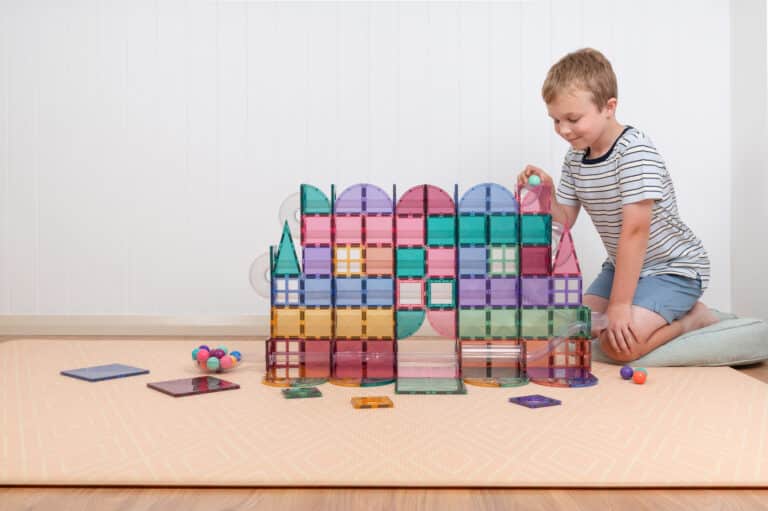
Open-ended toys like CONNETIX are perfect for this because there’s no single way to play, which invites creativity and problem-solving. Plus, when things inevitably don’t go as planned (hello collapsing tower, little brother misfiring a ball or the dog’s tail getting overly involved), your child gets a safe space to practice adaptability.
Quick Tip: Tone matters just as much as words. Be genuinely excited when you notice their effort – it makes your praise feel authentic and encourages them to keep trying.
Turn frustration into a game! Say, “Let’s do a ‘reset’ challenge. Can we start over and make it even better this time? I wonder what different pieces we could use.”

Emily Hanlon, otherwise known as The Playful Psychologist, is a Clinical Psychologist from Sydney. She is also the proud mum of 4- and 1-year old boys, and is expecting her third baby this year. Emily has a specific interest in autism spectrum disorder and developmental delay. She has experience providing individual and group therapy for children, adolescents, and adults with a variety of presentations including ASD, Attention Deficit Hyperactivity Disorder (ADHD), mood-related disorders, anxiety, poor social skills, and other behavioural concerns. Emily draws on her own personal experiences of having a brother on the Autism Spectrum, and uses her unique first-hand experience, to facilitate her own therapeutic practice. Emily started The Playful Psychologist to share her love of creativity within her work. She enjoys sharing her ideas, and also loves learning from others! As a psychology student, and a young psychologist, she always wished she had somewhere to turn for inspiration - and that is what she hopes to do for educators, parents, and psychologists alike! Emily is extremely proud of the online community she has created to support the social and emotional development of children by upskilling the adults who support them.
When structures are pushed down, fall or simply don’t work out, it’s tempting to jump in with a solution. But hold that thought! Instead, empower your child to think critically and problem-solve.
Try these phrases to guide their thinking:
A current favourite phrase in our house to use with our 4.5-year-old is ‘how can we fix this?’ . Does he always problem solve independently? Of course not! But this gentle prompt encourages him to try and lets him know we are there to scaffold him if he needs us. By framing setbacks as opportunities, you’re teaching your child that challenges are just puzzles waiting to be solved.

Create a challenge where your child uses their CONNETIX to build a bridge sturdy enough for a toy car. If it collapses, resist the urge to fix it for them. Instead, brainstorm together. “What happens if we add more tiles to the base?” or “Should we try making the bridge shorter?” or “I wonder whether we need to try different pieces.”
Adaptive kids are flexible kids! They can pivot when things don’t go according to plan. During play, encourage flexibility by introducing playful twists:
These small shifts help children understand that change isn’t something to fear – it’s just a new opportunity to try something different.
Vocabulary Tip:
Use words like adjust, adapt and change often. For example:
Another favourite phrase we use often in our home is, “Hey! Cool problem-solving!” It’s simple, it’s enthusiastic and most importantly, it shifts the focus from the outcome to the process. Praising the effort and creativity a child puts into solving a problem is far more impactful than focusing on whether their tower stayed up or their bridge held together.
Why? Because it builds intrinsic motivation. When kids hear you acknowledging their thinking, experimenting and adapting, they begin to value the how of their actions rather than just the what. This lays the groundwork for a growth mindset; the belief that skills and abilities grow with effort and perseverance.
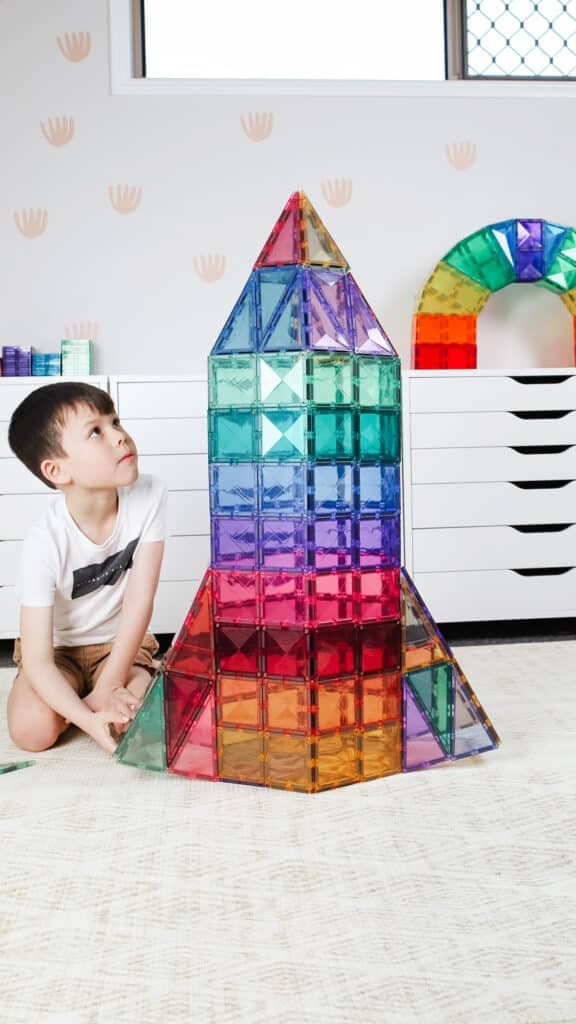
Here are some variations you might use:
These phrases are easy to sprinkle into play and can make a big difference in how your child views challenges. Instead of fearing mistakes, they start to see them as part of the fun.
When a structure collapses or doesn’t go as planned, jump in with curiosity: “Hmm, what’s another way we could make it work? I bet you have a great idea!” This not only encourages problem-solving but also shows your child that their ideas are valuable.
By celebrating the process with simple phrases like “cool problem-solving,” you’re giving your child a toolkit for resilience, creativity and confidence; skills that will serve them far beyond playtime.

Big feelings often arise during play (well, at least they do in our household), especially when things don’t go as planned. This is where CONNETIX offer a golden opportunity to practice emotional regulation.
When frustration bubbles up, try these responses:
Set up a team challenge, like building a shared “city.” Assign roles: one child gathers CONNETIX, another designs buildings and another oversees “construction.” If disagreements arise, guide them gently:
This kind of play teaches negotiation and perspective-taking in a hands-on, playful way.
When the play session ends, take a moment to reflect with your child. This helps them recognise the skills they’ve practiced and feel proud of their progress.
Ask open-ended questions like:
These reflections reinforce adaptive skills and help children connect their actions to their emotions.
Adaptive skills are like a superpower for kids, helping them thrive in an ever-changing world. And as parents, you’re the guide who can gently steer their play in ways that foster these skills.

Unlike toys with a set “right” way to use them, CONNETIX encourage endless possibilities. This open-ended nature mirrors real-life problem-solving and adaptability: there’s rarely one solution and creativity often saves the day!
Next time you see your child’s tower crumble or hear them grumble about a tricky design, remember: this is more than play. It’s a safe space to learn, grow and practice adaptability.
And if you manage to sneak a hot coffee in while they’re engrossed in their “big build”? Well, that’s just the icing on the cake.
Ready to see these adaptive skills in action? Grab those tiles, roll up your sleeves and watch the magic of MESH learning unfold!
Menu
 Australia