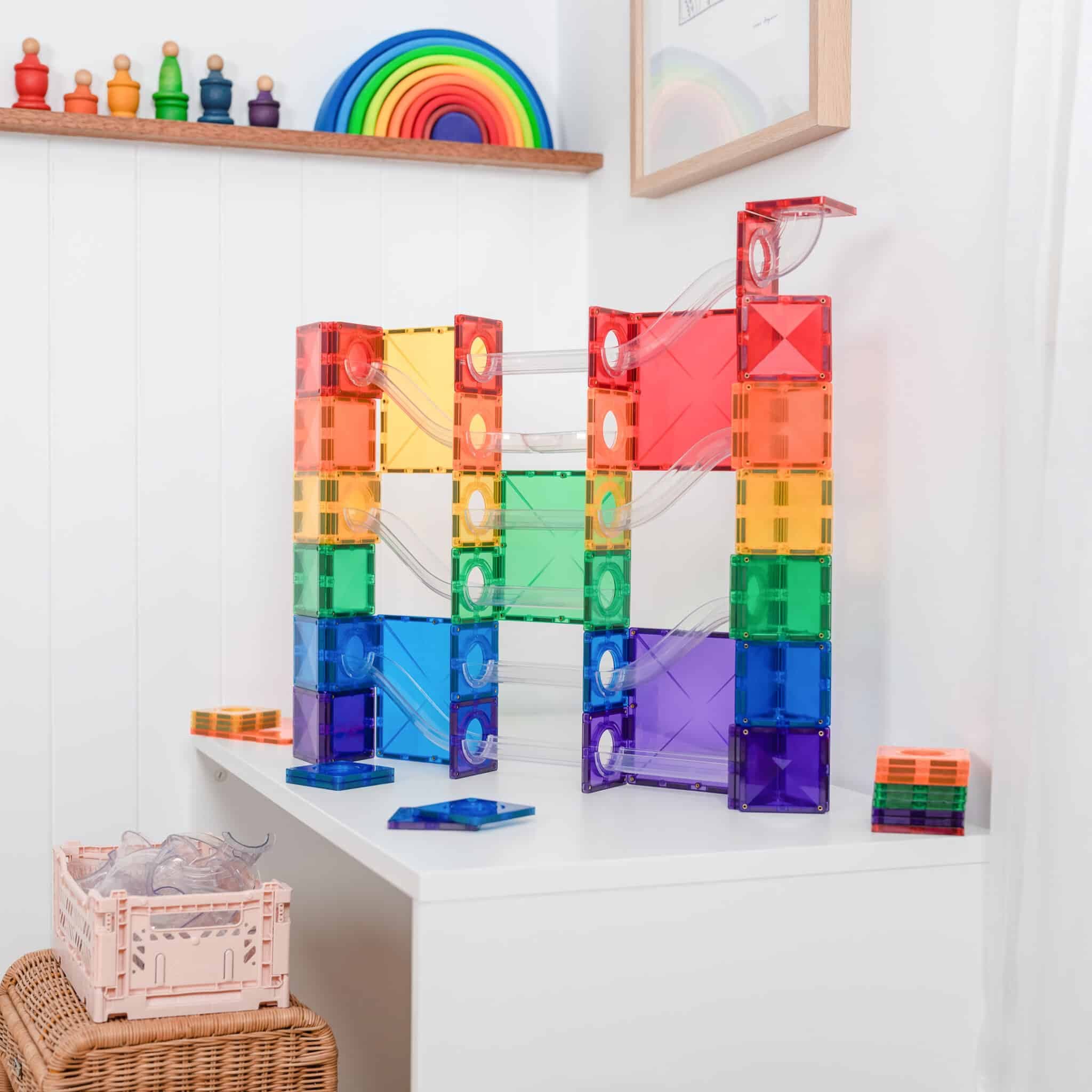
Before diving into the magic of open-ended play and problem solving with CONNETIX, it’s helpful to understand a concept called MESH. MESH stands for Mental, Emotional and Social Health development. This encompasses the key areas of growth that are essential for children to thrive. Through play, children actively engage all aspects of MESH. This includes problem solving, perseverance and resilience, adaptation, conflict resolution, self-regulation, self-advocacy, cognition and communication. The beauty about MESH toys is that they are engaging, fun, and also reinforce fundamental life skills.
In this blog, I want to focus on the “Cognitive” and “Emotional” aspects of MESH, particularly how problem solving and resilience develop through play. In future posts, I’ll dive deeper into how social skills and physical health are also strengthened in these early, playful years.
Now, let’s explore how open-ended toys like CONNETIX help nurture mental growth, emotional regulation and problem-solving skills.
The Power of Problem-Solving Through Play

Tags

As parents, we’re always on the lookout for toys that not only keep our children entertained but also help nurture important skills. We’ve all been there watching our children playing and wondering, “What are they actually learning here?” They might be building towers, making shapes, or simply moving CONNETIX around. It looks like play (because it is!), but here’s the secret: play is how children learn. When children engage with open-ended toys like CONNETIX, they’re not just stacking and connecting. They’re problem-solving, thinking critically, and building the foundation for important cognitive skills.
When kids are using CONNETIX to build that rainbow bridge or a castle, they’re developing more than just fine motor skills. Here’s what might be happening behind the scenes:
Next time you’re observing your child, try asking yourself, “What problem are they trying to solve?” You’ll be amazed at the answers that pop up when you think of play this way!
So, how can we, as parents, support and recognise these crucial moments of learning while still allowing our kids the freedom to explore?
Spoiler: it’s easier (and more fun) than you think.

First things first, let’s tackle why open-ended and free play are so important for child development. Open-ended play is exactly what it sounds like: play that has no right or wrong way to engage. The child decides what to do, how to do it, and what the outcome will be. They are in complete control and there is no limit to what they can do or create.
CONNETIX are the ultimate open-ended toy. They don’t come with instructions on how to play (although, you can use the inspiration book if your child needs a little prompt, I know my four-year-old loves looking at it for new ideas for his creations). Instead, your child decides whether they’re going to build a rocket, a house, or something completely unexpected like a “rainbow bridge” for their dinosaurs! This kind of play encourages creativity, flexibility in thinking, and the ability to pivot when things don’t go as planned. Free play, where children play without structured guidance, also allows them to practice self-regulation and independence. They’re in control of the play session, without adult intervention, deciding what they need and how to approach their goal. And let’s be honest, free play offers parents those golden moments to sip a hot coffee! At this point in my life with three kids, I’ll take all the hot sips of coffee I can get!
We know play is crucial to child development, but not all play is created equal. What makes CONNETIX different from other toys, is their ability to challenge your child’s thinking while keeping things fun. You can teach the most valuable life lessons without actually having to plan the lesson. Picture this: your little one is trying to build a bridge or a tall tower. Sounds simple, right? But what happens when the tower keeps toppling over? That’s where the magic happens.
Your child starts to think (or scream), “Why did it fall? How can I fix this?” This is problem-solving in action. They’re learning to experiment, to tweak their approach, and to persevere until they find a solution. All without realising they’re building essential cognitive skills.
Now sometimes the frustration is simply all too much for our little ones to manage alone. Cue the frustration and tears (from both of us really). This is where we, as parents, can gently coach them through one of life’s greatest lessons: how to handle setbacks and problem solve.
Here’s a script you can use with some prompts:
This language not only helps your child recognise that it’s okay to feel frustrated but also encourages them to come up with possible solutions to their problem. It also allows them to see that problem-solving often involves trying different strategies.

One of the other fantastic things about CONNETIX is their versatility. There’s no “right” way to play with them. Kids can build whatever their imagination dreams up – castles, tunnels, boats, you name it! This open-ended nature means they’re constantly testing new ideas and learning from mistakes. If one configuration doesn’t work, they’ll quickly try another. This kind of independent exploration is fantastic for developing resilience and critical thinking.
It’s like a mini lab experiment happening right in your living room. Except mess free (praise be!)
Want to build on the skills they’re learning? Language is your best tool. Simply narrating what your child is doing during playtime introduces vocabulary they might not have yet. Here’s how:
Building structures with magnetic tiles encourages children to think in three dimensions. They’ll need to understand how pieces fit together and how balancing certain parts impacts the whole structure. This is fantastic for spatial awareness: a key component of problem-solving and logical reasoning.
I still remember my eldest figuring out how to make a “super tall” tower that wouldn’t topple over. There was a lot of trial and error, and yes, maybe a tiny bit of frustration (from both of us). But the look of satisfaction on his face when he finally succeeded? Pure gold!
Here’s where it gets really interesting. As kids engage in this open-ended, imaginative play, they’re also strengthening their executive function skills. These are the brain processes responsible for planning, decision-making, and controlling impulses – skills we all need to navigate life’s tricky moments.
By playing with open-ended toys like CONNETIX, children are learning to set goals (like building the highest tower), plan ahead (which tiles will they need first?), and even practice self-regulation when things don’t go according to plan. All essential ingredients for problem-solving.

As parents, we often feel the urge to jump in and help when things don’t go as planned (guilty!). But when it comes to developing problem-solving skills, it’s important to give children the space to figure things out on their own. Step back and let them experiment. You can ask gentle guiding questions like, “Hmm, I wonder what would happen if you tried a different shape?” or “What can we do to make this bridge stronger?”
It is however important to not jump in at every hint of frustration, and instead let them experience small setbacks; because let’s be honest, problem solving is as much about learning from failure as it is about success. And they might surprise you with their creativity and resilience!
Want to help your child get the most out of playing with CONNETIX? Here are a few ideas:
CONNETIX aren’t just toys; they’re tools for developing critical problem-solving skills. Whether your child is learning how to balance a tall tower, figuring out how to build a sturdy bridge, or working with a friend to create a whole new world, they’re honing skills that will last a lifetime.
So next time you’re setting up playtime, think about how that simple click of a magnetic tile might just be the first step in solving life’s bigger puzzles. And maybe, just maybe, you’ll get that peaceful (hot) cup of coffee after all!

Emily Hanlon, otherwise known as The Playful Psychologist, is a Clinical Psychologist from Sydney. She is also the proud mum of 4- and 1-year old boys, and is expecting her third baby this year. Emily has a specific interest in autism spectrum disorder and developmental delay. She has experience providing individual and group therapy for children, adolescents, and adults with a variety of presentations including ASD, Attention Deficit Hyperactivity Disorder (ADHD), mood-related disorders, anxiety, poor social skills, and other behavioural concerns. Emily draws on her own personal experiences of having a brother on the Autism Spectrum, and uses her unique first-hand experience, to facilitate her own therapeutic practice. Emily started The Playful Psychologist to share her love of creativity within her work. She enjoys sharing her ideas, and also loves learning from others! As a psychology student, and a young psychologist, she always wished she had somewhere to turn for inspiration - and that is what she hopes to do for educators, parents, and psychologists alike! Emily is extremely proud of the online community she has created to support the social and emotional development of children by upskilling the adults who support them.