Menu
Shipping to Australia
Australia
Menu
Australia
How to Use CONNETIX to Foster Self-Regulation
By framing frustration as part of the process, children learn that setbacks are not reasons to give up, but opportunities to try something different.
Over time, this builds a habit of pausing before reacting, a crucial skill for emotional regulation.
This practice helps children strengthen their ability to control immediate desires and work towards a shared goal.
Rigid thinking can lead to meltdowns when things don’t go as expected. Encouraging flexibility helps kids adapt when the “perfect” plan doesn’t work out.
Flexible thinking builds resilience and reduces frustration when things don’t go as planned.
Physical regulation (the ability to calm the body) is just as important as emotional regulation. Integrating calming techniques into play can help children learn to self-soothe.
Making these strategies part of playtime helps children practice them in a low-pressure setting, so they’re more likely to use them when needed.
Tags
If you’ve been following along with previous blogs, you already know that CONNETIX magnetic tiles are more than just a colourful way to cover your living room floor; they are one of the most versatile, open-ended toy options on the market. These tiles are also an incredible tool for fostering Mental, Emotional and Social Health (MESH) in young children. From perseverance to problem-solving, these little tiles pack a developmental punch.
In the last blog, we explored how CONNETIX can help children develop conflict resolution skills (because let’s be honest, there’s no shortage of sibling spats over who gets the last red tile). Today, we’re diving into another crucial life skill: self-regulation.
If conflict resolution is about navigating the storm, self-regulation is about developing the skills to calm the storm before it escalates. It’s the difference between a child melting down over a toppled tower and a child taking a deep breath, problem-solving, and trying again.
And while self-regulation takes time to develop, play-based strategies, like using CONNETIX, can make this learning process both engaging and effective.


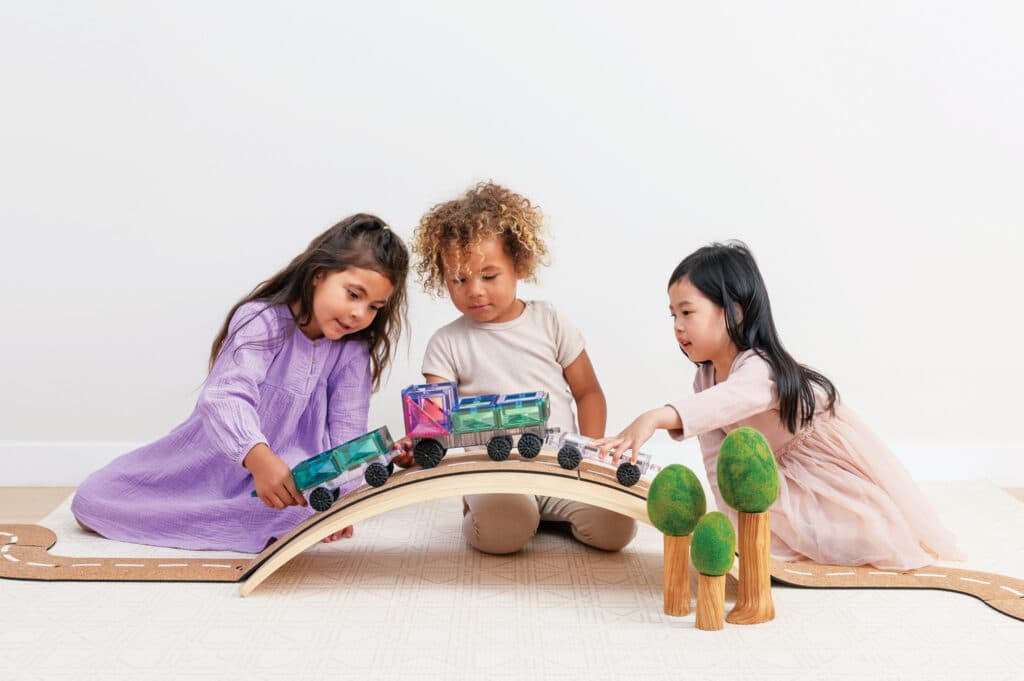


Let’s recap…
Self-regulation is one of the most valuable skills a child can develop. It sets the foundation for resilience, problem-solving and positive social interactions. The best part? You don’t need a complicated system to teach it, just a pack of CONNETIX tiles, a bit of patience and a willingness to model regulation yourself (even when your own tower falls over, again).
So, next time your child’s tower crashes down, resist the urge to rebuild it for them. Instead, take a deep breath together, offer a supportive word, and watch as they learn to try again. Because every wobble, every rebuild, and every “let’s try something different” moment is a step towards mastering self-regulation—one magnetic masterpiece at a time.

Emily Hanlon, otherwise known as The Playful Psychologist, is a Clinical Psychologist from Sydney. She is also the proud mum of 4- and 1-year old boys, and is expecting her third baby this year. Emily has a specific interest in autism spectrum disorder and developmental delay. She has experience providing individual and group therapy for children, adolescents, and adults with a variety of presentations including ASD, Attention Deficit Hyperactivity Disorder (ADHD), mood-related disorders, anxiety, poor social skills, and other behavioural concerns. Emily draws on her own personal experiences of having a brother on the Autism Spectrum, and uses her unique first-hand experience, to facilitate her own therapeutic practice. Emily started The Playful Psychologist to share her love of creativity within her work. She enjoys sharing her ideas, and also loves learning from others! As a psychology student, and a young psychologist, she always wished she had somewhere to turn for inspiration - and that is what she hopes to do for educators, parents, and psychologists alike! Emily is extremely proud of the online community she has created to support the social and emotional development of children by upskilling the adults who support them.