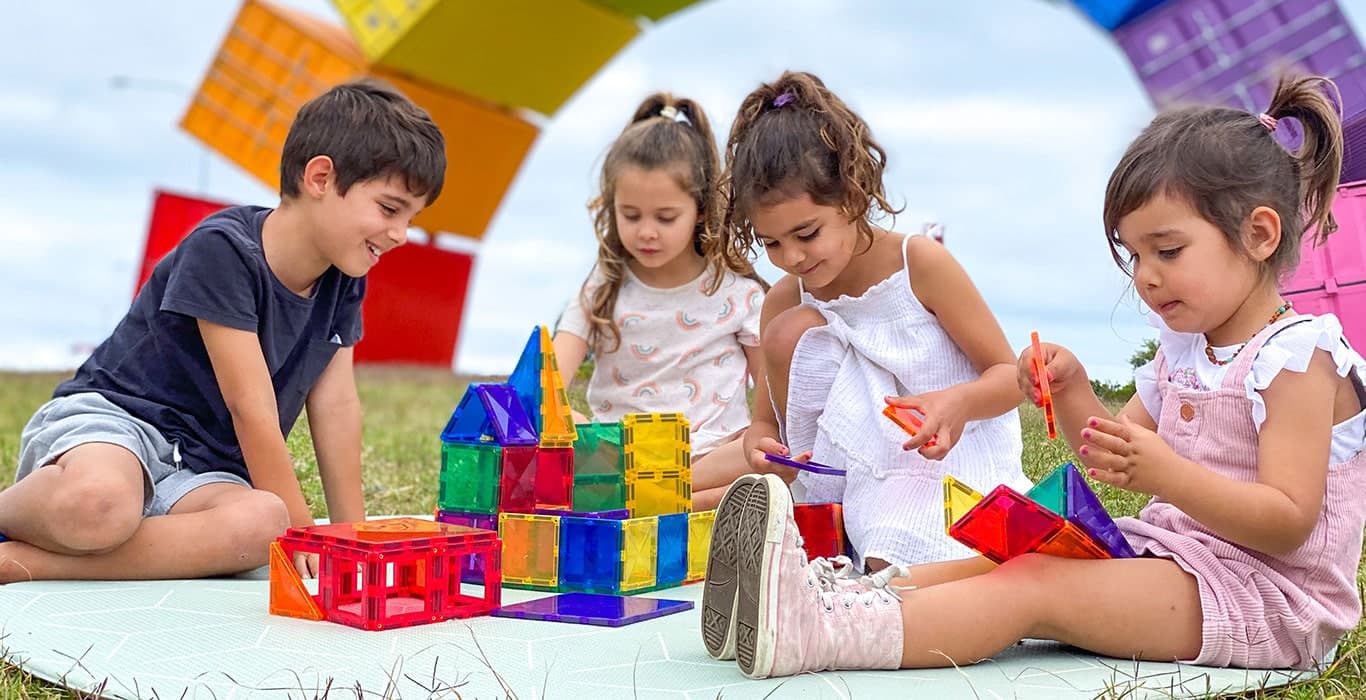
Encountering problems with play is normal, since a lot of the time things don’t go as planned and obstacles need to be overcome in order for a child to reach their end goal. For example, when building a CONNETIX castle, it may collapse a few times before children realise it needs a sturdy foundation. Sometimes children are put in a position where they must accept their goal is unachievable – maybe they don’t have enough CONNETIX to construct what they envisioned. In these scenarios children can be supported to develop strategies for dealing with their feelings; learning to problem solve to achieve their goal or navigate around roadblocks to continue playing.
Play often involves children forming an idea of what they will do before trying to accomplish it. Sometimes they are put in a position where they must accept their goal is unachievable – maybe they don’t have enough CONNETIX to construct the perfect house they envisioned. With support, children can learn how to navigate around these situations and continue playing, rather than fixating on the issue.

Through play with peers, children often need to negotiate with others in terms of what to build and what role they can contribute. Sometimes their ideas will be rejected, other times they will find their help is not wanted or needed. While these experiences can be a hard emotional process for a child, they provide opportunities to build on their social resilience and value the different ways they can contribute in collaborative play.
In the early years, social awareness (i.e. empathy) is often experienced through collaborative play and negotiating interpersonal boundaries. For example, when presented with the option to build alone or with others, a child will learn to consider and communicate their own needs, “I just want to make my own tower!”, alongside becoming aware of others, “Billy really needs my help to build a tower!”. We can empower children to recognise their interpersonal boundaries and how to articulate them respectfully, as well as acknowledging their peers’ perspectives.
Forming confident relationships and developing a sense of belonging is crucial for social development. It not only shapes who children are, but also who they can become. Whether it is learning to be happy and comfortable with their playmates or finding a group with a unifying identity (e.g., peers who are enthusiastic about a particular activity like building CONNETIX towers), early childcare settings provide many opportunities for children to experience belonging.
Scientists have found that developing motor-skills early in life, such as those built through tactile play, have a direct relation to a child’s development of language skills. This doesn’t mean that you need one to develop the other, but it is thought that rhythmic movements and assembling/disassembling things (such as CONNETIX magnetic tiles) are precursors to forming rhythmic speech and experimenting with language structures at a young age.
So there you have it! Just a few ways open-ended play benefits the social and emotional development of children, and how we can facilitate these experiences. It is not surprising to see how integral play experiences are to children’s social and emotional development, and why so many parents and early childhood educators alike value high quality, open-ended resources like CONNETIX to support them. The possibilities for playing and learning with CONNETIX are open to the limits of your imagination!
If you would like to join the CONNETIX fun, connect with us on our social platforms or email us at hello@connetixtiles.com. Our Instagram, Facebook, Pinterest and YouTube channels are brimming with ideas and inspiration to kickstart your CONNETIX play.
Tags

The CONNETIX team of play experts is made up of qualified teachers, early childhood educators, industry specialists and dedicated parents who are passionate about open-ended play, STEAM learning and quality resources. Together, they share their expertise, experience and love of all things CONNETIX to inspire play-based learning.