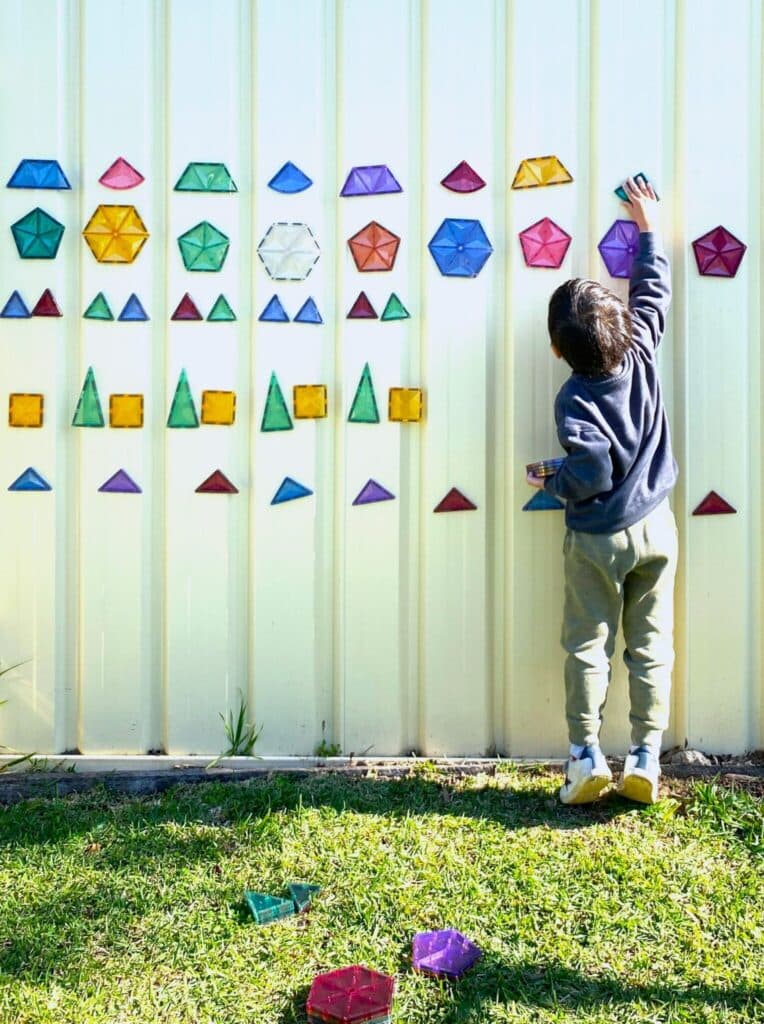
Incorporating Maths into everyday activities help children to understand it is part of their everyday life. We can set up invitations to play and learn by using games that involve mathematical concepts. This creates an enjoyable learning environment for maths exploration at home. Each activity using these magnetic tiles takes less than 5 minutes to set up and are aimed at young children around 3-4 years old.
1.Muffin tin counting
2. Magnetic number line
3. Fill in the shapes
4. Continue the pattern
5. Symmetry puzzles
Tags

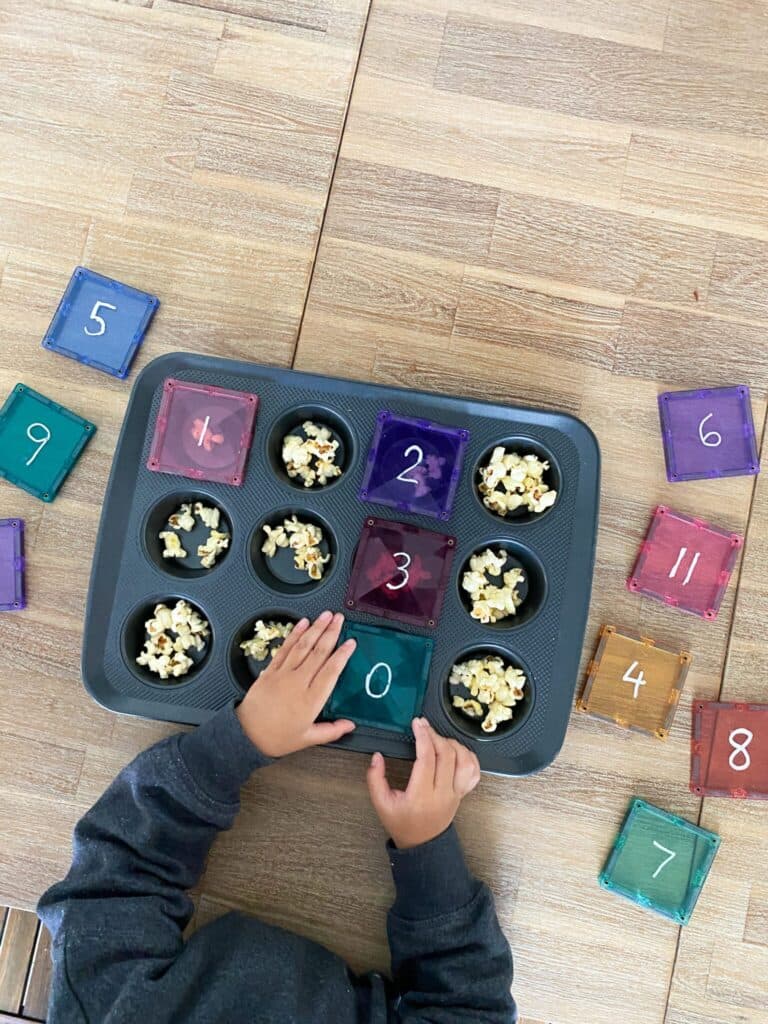
Counting food or any loose parts that children use is a great way to incorporate 1:1 correspondence counting in a natural and relevant way. This is an important skill that involves counting each object in a set only once. It teaches children to associate each item to one number and to count in the correct order. It sets the foundation for other numeracy concepts they will encounter later on.
Activity: Using a chalk marker, write the numbers 0-11 on a magnetic tile and fill each compartment of the muffin tray with counters, buttons or whatever you can find at home. For this activity, I placed popcorn into the muffin tin and my 4yo counted each one, then placed the corresponding number tile on top.

A number line is a horizontal line that shows numbers in order. It is a visual way to help children understand place value, counting forwards, counting backwards, comparing numbers and even for learning addition, subtraction and fractions. Being familiar with a number line helps develop number sense, that is, the ability to work with numbers in a flexible way. When a child has a strong grasp of the relationship between numbers rather than through memorisation, they are better equipped to use efficient strategies when problem solving. Children will eventually move on to visualise number lines in their heads and this will develop their mathematical fluency and mental arithmetic strategies. Number lines are also used in the older years as they look at decimals and negative numbers.
Activity: There are many ways to use number lines. For this activity, I used a chalk marker to write the numbers 0-20 on our pastel CONNETIX small squares and placed them on our garage door as it has a large magnetic surface. I include the digit “0” on it so that children can see how it relates to other numbers and that it is smaller than one. This activity can be done on the floor or dining table too, but using a vertical surface encourages more movement and strengthens other physical motor skills. Having the surface at eye level also helps the child to focus better on the activity.


Similar to patterns, the concept of symmetry will often arise as children play and create designs with a symmetrical pattern. When we observe children creating a symmetrical structure, we can introduce this concept by discussing the shape, pattern and lines of symmetry. We can teach the vocabulary and mathematical language, for example: “When we draw a line down the middle, this side reflects this side. This is called symmetry” or “This is symmetrical.”
Once children understand symmetry, they will start to notice it everywhere and learn to visualise how shapes can be mirrored. When children predict and complete a symmetrical pattern, they are exercising their cognitive skills as they engage in logical thinking and problem-solving. Symmetrical puzzles or “draw the other half” activities are tactile ways to engage children in learning symmetry.
Activity: Using a chalk marker, draw symmetrical images or patterns on 2 CONNETIX. Split them up and mix them around for your child to put together. Alternatively, create a symmetrical pattern on one half of the table and invite your child to finish the other half.

Jess is a primary school teacher turned stay at home mum. She has 5 children ranging from 8 months old to 7 years old. Jess believes learning happens naturally through play. She has intentionally curated open-ended toys in her home to foster creativity, a love for play and a desire for learning.